Skip to content

The Machine · Recipes

Sympathetic Resonance Field

Design stage

Updated 2026-10-20

An autoharp lies on its back with every string free, and nobody plays it. A transducer breathes noise into its box, narrowed to a note, and the strings that hold that note, as their own pitch or as an overtone, pick it out of the hiss and ring on after the breath.

Loading the model

Drag to turn · scroll to zoom

Printed

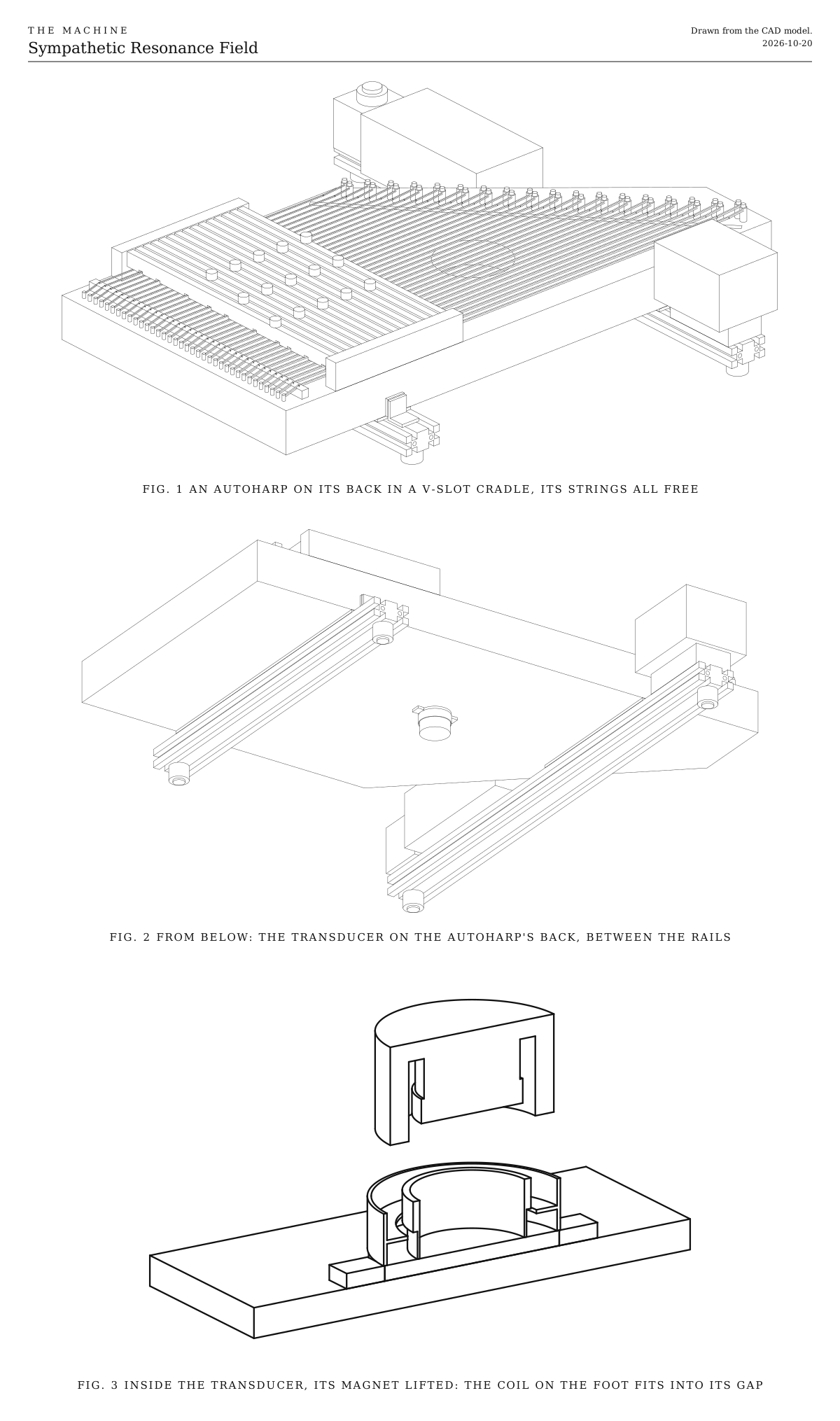
3DThe whole element. This is the version we started with, a typical autoharp on its back in a V-slot cradle, its chord bars up and untouched. Nothing is printed and nothing moves; the transducer is underneath, stuck to the autoharp's back. The strings are drawn thicker than life so they show.

Overview

Cost, roughly
About $310
Building
An afternoon
Difficulty
Easy

Anatomy

1
Energy source
An amplifier and a transducer breathe noise into the autoharp's box, each breath narrowed to a note
2
Control
Which note each breath is narrowed to, and how loud
3
Sounding body
An autoharp's 36 strings, all free, and its box
4
Reset
None needed; the strings ring out on their own
3D views. The autoharp in its cradle; from below, the transducer on its back between the rails; and the transducer cut in half with its magnet lifted, to show the coil that pushes the box. Drawn from the CAD model.
Fig. 13D views. The autoharp in its cradle; from below, the transducer on its back between the rails; and the transducer cut in half with its magnet lifted, to show the coil that pushes the box. Drawn from the CAD model.
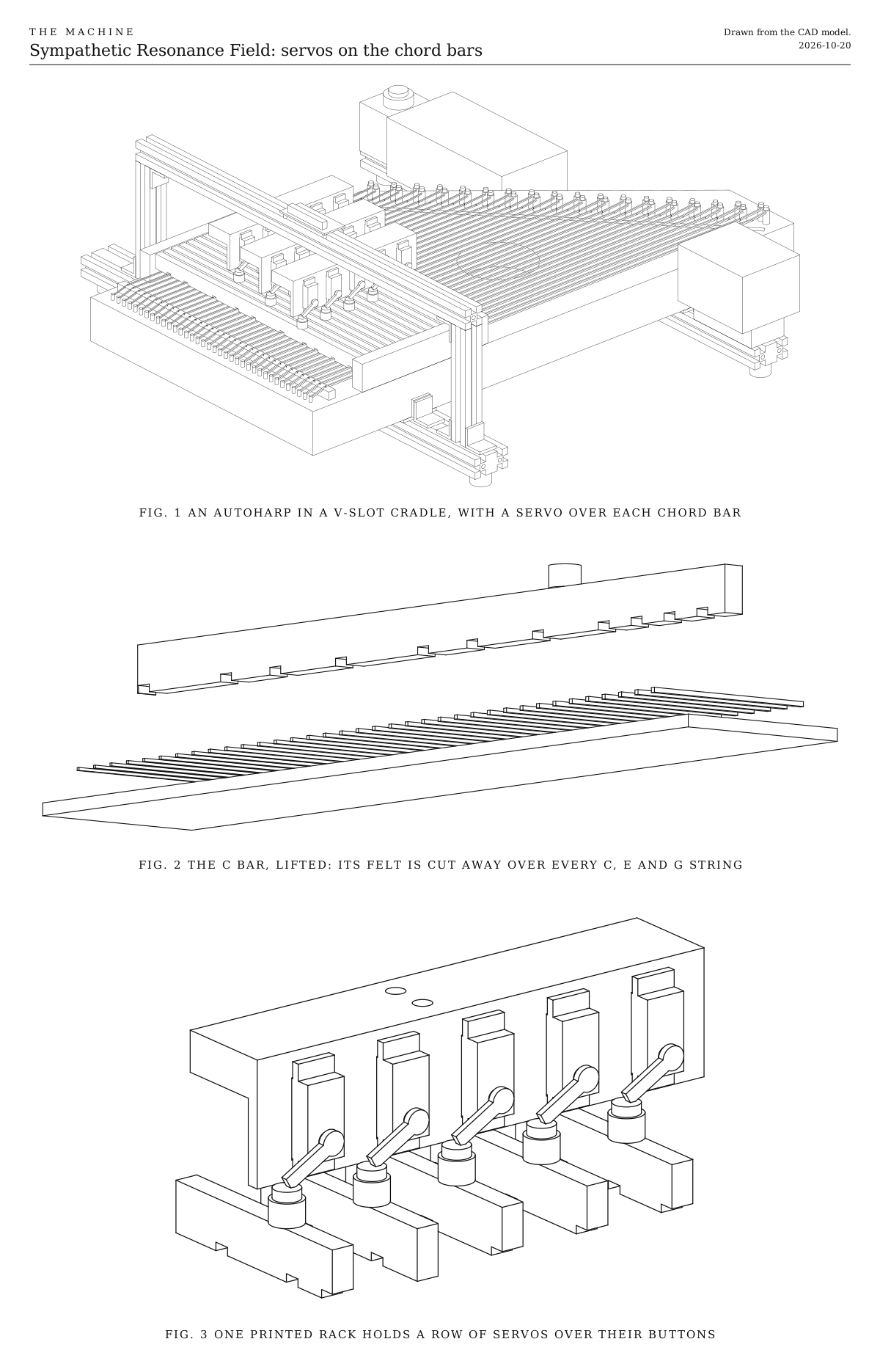
With servos on the chord bars. The variation where fifteen servos press the chord bars, so the bars choose the chord. Its CAD script and its three printed racks are in the downloads.
Fig. 2With servos on the chord bars. The variation where fifteen servos press the chord bars, so the bars choose the chord. Its CAD script and its three printed racks are in the downloads.
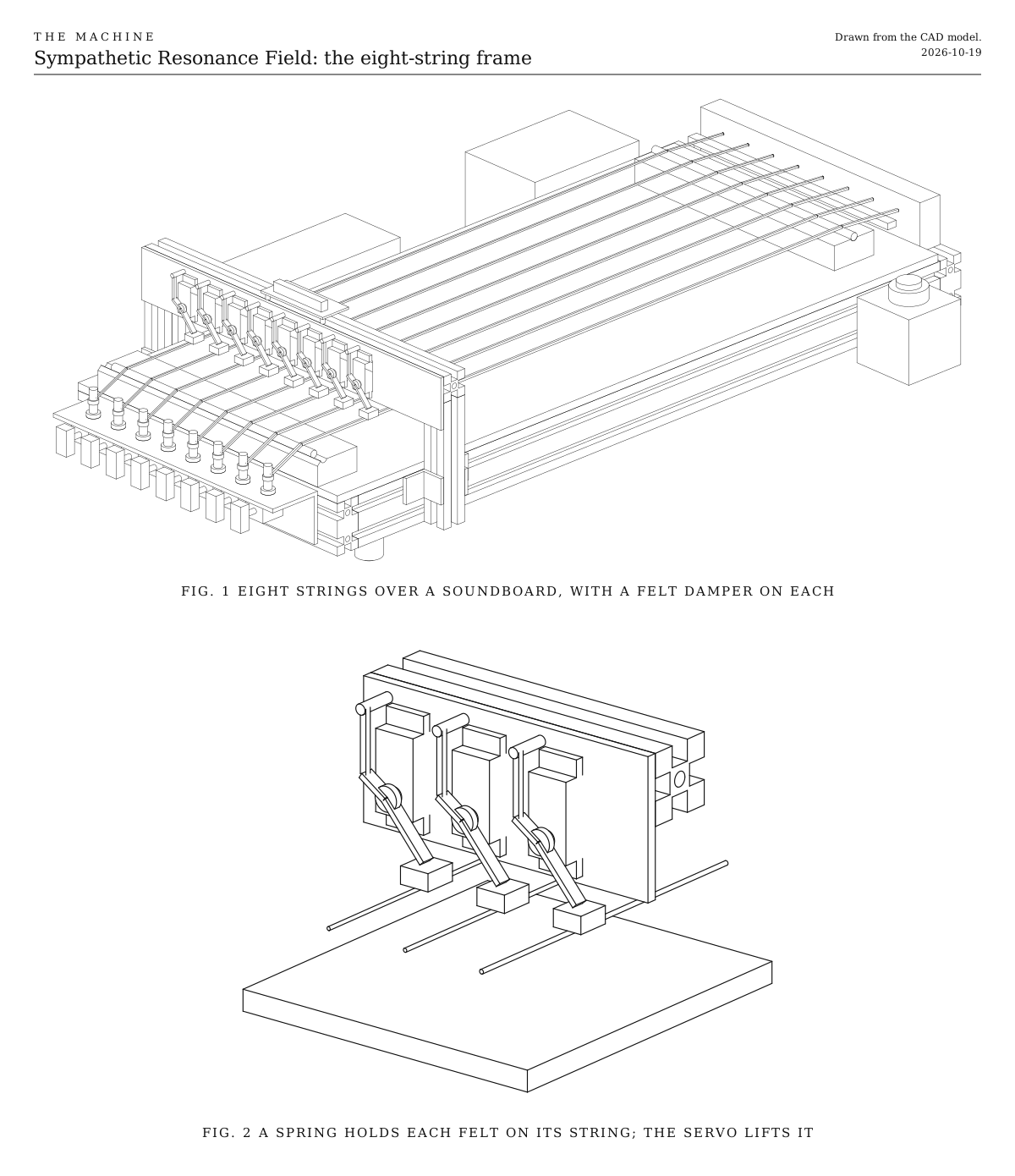
The other body. Eight guitar strings over a plywood soundboard on a V-slot frame, drawn with a sprung felt damper and a servo on each string, which you can leave off. Its CAD script is in the downloads.
Fig. 3The other body. Eight guitar strings over a plywood soundboard on a V-slot frame, drawn with a sprung felt damper and a servo on each string, which you can leave off. Its CAD script is in the downloads.

How it works

  • An autoharp lies on its back in a cradle of V-slot extrusion. Its chord bars stay up, so all 36 of its strings are free, and nobody plays it.
  • The box breathes. A surface transducer stuck to the autoharp’s back shakes the whole box with breaths of noise the ESP32 makes, each narrowed to the note the signal asks for. The box sounds like wind.
  • The strings pick the notes. A string answers only at its own frequencies, its note and its overtones at two, three, four times that note and up, the way a swing builds only from pushes in time with it. So a breath at G4 wakes the G4 string, and also G3, C3 and G2, which all have G4 among their overtones. A breath at E5 wakes six strings. One breath sets a family of strings singing the same pitch, each in its own color, and a breath at a low string’s overtone makes it sing a pure harmonic over a silent note.
  • It plays in breaths. The breath stops, and the strings ring on for several seconds. You hear the wind, then the note hanging in the air.
  • Nothing mutes it. Each note rings out on its own, and the next breath layers over what’s still ringing, so the music is slow and overlapping.
  • The transducer is a speaker without a cone. A coil of wire on a flat foot, stuck to the box, sits in the gap of a heavy magnet hung on a soft ring. The audio current through the coil pushes against the magnet; the magnet is too heavy to move much, so the push goes into the box, and the box moves in step with the sound.
  • An ESP32-S3 runs it. It hears the shared wireless signal and makes each breath. Its notes are pitches. A hit sends a breath narrowed to that note, the loudness sets its level, and a held note keeps breathing. Quiet stops the breaths and lets the strings ring out, and a stop, or losing the signal, cuts the amplifier.

Notes

  • This is a first design, drawn but not yet built. The 3D model shows a typical 15-bar autoharp; yours will differ.
  • Costs in the ingredients are rough estimates for budgeting, not checked prices.
  • Firmware comes with the broadcast control system. For a first test, any ESP32 audio example that plays filtered noise will do.

References

  • Sympathetic strings. Sitar, viola d’amore, piano with the sustain pedal down. Precedent for the sympathetic resonance field.
  • The Aeolian harp. Strings played by the wind alone, which sound their overtones rather than their notes. The breath here is a wind made of noise.
  • The autoharp. Its strings and box are borrowed whole; its chord bars stay up.

Parts

Ingredients

KindPartQtySourceEach
BoughtAutoharp, 36 stringsYour choice: see The bodyWe started with a common 15-bar model. Used ones cost less; check that it holds its tuning for a day.1·$180.00
BoughtV-slot aluminum extrusion, 20 x 40 mm, 390 mm, for the first cradle rail1·$10.00
BoughtV-slot aluminum extrusion, 20 x 40 mm, 550 mm, for the second cradle railLonger than the first, to carry the battery, the electronics and the stop button beyond the autoharp.1·$13.00
BoughtCorner brackets for 20 mm V-slotWith rubber against the box, they stop the autoharp's long edges.3·$0.80
BoughtM5 screws, T-nuts and washers for 20 mm V-slot, assorted1·$6.00
BoughtRubber feet with M5 screws4·$1.00
BoughtRubber strip, 3 mm thick, about 1 mAlong the rails under the autoharp and on the edge stops, so the box rests softly and can ring.1·$4.00
BoughtHook-and-loop strapsOne over the autoharp at each rail, to hold it down.2·$1.50
BoughtSurface transducer, 32 mm, 4 Ω, 20 to 40 WYour choice: see The transducerFor two, buy two; see How many transducers.1·$20.00
BoughtStrong double-sided foam tape (VHB), a short lengthHolds the transducer to the autoharp's back, and can come off later.1·$3.00
BoughtPCM5102A converter boardYour choice: see The amplifierTurns the ESP32's digital audio into a signal for the amplifier.1·$5.00
BoughtTPA3116D2 amplifier board, stereo, 2 x 50 WYour choice: see The amplifierEach channel drives one transducer. The second channel is wired to its input from the start, so a second transducer needs only two speaker wires.1·$12.00
BoughtSpeaker wire, 18 AWG, 1 m, and a short shielded cable1·$3.00
BoughtESP32-S3 development boardThe board every element uses, as on the Control page. It makes the breaths and filters each to its note.1·$6.00
Bought5 V buck converter, 3 A, for the ESP321·$3.00
BoughtBattery adapter for the shared power-tool platformThe amplifier runs from the battery, through the fuse, the stop button and the relay.1·$15.00
BoughtThe listener parts every element carries, as on the Control pageA blade fuse holder and a 5 A fuse (7.5 A with two transducers), a latching stop button with a spare contact, the status light, the number switches and their resistors. The stop switch under Choices has a plain two-pole switch in place of the stop button.1Link$12.00
BoughtMomentary push button, normally open, for the test buttonA short press plays each note once, and a long press relearns what the element can by itself. Any small panel button that closes while it's pressed will do.1·$1.00
BoughtRelay module, 5 V, high-level trigger, contacts rated 10 AThe switch the amplifier's power goes through.1·$2.00
BoughtResistor, 10 kΩHolds the relay off while the ESP32 starts.1·$0.10
BoughtProject box, about 160 x 80 x 60 mm, for the electronicsYour choice: see The electronics1·$8.00
Total$312.50

Tools

  • The autoharp's tuning wrench, which comes with it, and a clip-on tuner
  • Hex keys, 2.5, 3 and 4 mm
  • Small screwdriver
  • Scissors, for the rubber strip
  • Soldering iron
  • A multimeter, to set the converter

Choices

Decisions that are yours to make. Where we started is the version in the 3D model and the ingredients: a starting point, not the right answer.

The body

Which strings does the box shake?

An autoharpWhere we started

SoundAbout 36 strings over a resonant box, each free to answer, so a breath wakes a whole family of strings at once

Bought, about 3 kg, and nothing to build but the cradle. Its chord bars stay up and touch nothing. It drifts out of tune.

A zither or psaltery

SoundMuch the same, often with more strings and a bigger box, and no bars at all

Fewer are sold, and some are tuned to one key. The cradle fits most of them.

An old upright piano, its sustain pedal wedged down

SoundOver two hundred strings and a huge soundboard, the deepest and loudest ring of these

Often free for the hauling, but it weighs 200 kg, won't sit on extrusion, and needs a piano tuner.

Eight strings on a V-slot frame

SoundEight guitar strings over a plywood soundboard, tuned to exactly the notes you choose

A weekend of woodworking for eight notes, about the same cost in all. Its drawing and CAD script are in the downloads; it's drawn with a damper per string, which you can leave off.

Whatever the body, the transducer, the amplifier and the electronics stay the same.

The tuning

Which notes do the strings hold?

As sold, chromaticWhere we started

SoundEvery semitone across more than three octaves, so any note the signal asks for has strings to answer it

A wide breath wakes the neighboring semitones too, a cloud rather than a note. Keep the breaths narrow.

Retuned to one chord

SoundEvery string a note of one chord, so even wide noise rings that chord and nothing else

Retune all 36 strings, each a little up or down from where it sits. The element then has one harmony.

Retuned to one key

SoundThe notes of one scale, doubled across the strings, louder and fuller

Retune all 36 strings. Notes outside the key find no strings to answer them.

The breath

What sound goes into the box?

Noise narrowed to a noteWhere we started

SoundThe box breathes like wind, and the strings pull an exact pitch out of it. The note's own strings ring, and so do the lower strings that have it as an overtone.

The narrower the band, the cleaner the note and the softer the breath. We started with a band about a semitone wide.

Pure tones

SoundOne frequency, so it wakes only the strings that have that exact pitch as their note or an overtone, and rings them hardest and fastest

The box sings the note itself, so the strings only bloom around it.

A sawtooth on the note

SoundHolds every harmonic of its note at once, so it wakes the note's whole overtone family. A saw on C3 wakes the C3, C4, G4, C5, E5, G5 and C6 strings, a bright chord built from the harmonic series.

The box buzzes with the saw itself while it plays. A low note wakes the most strings, a high one only a few.

Full-range noise

SoundWakes every free string at once, a dense cloud on a chromatic autoharp, or a shimmering chord on one retuned to a chord

The loudest breath, and the least control

A click

SoundA single sharp pulse holds every frequency for an instant, so every free string gets a tiny kick at once, a ghostly strum across the whole autoharp

The quickest way to wake everything, and the most percussive; on a chromatic autoharp it rings as a cluster. A steady train of clicks works like a sawtooth on the train's rate, waking that note's overtone family.

A sweep

SoundA tone gliding up or down passes each string's note in turn, so the strings light up one after another, an invisible glissando that rings on behind it

A slow sweep wakes each string more fully than a fast one, and the box sings the glide while it moves. Sweep only across the strings you want.

Voices, recordings or the room

SoundThe strings ring only the parts that match their notes. Through a microphone, the autoharp rings in sympathy with the other elements and the audience.

A memory card board or a small microphone on the ESP32. The microphone can howl if it hears the box too well.

Any waveform the ESP32 can compute will do. The strings keep only the frequencies that match their notes and overtones, so the waveform decides which strings answer, and the firmware can use a different one for each note. Nothing can stream audio to the element, because it only listens to the broadcast signal, so every breath is made on the element.

The transducer

What shakes the box?

Surface transducer, 32 mmWhere we started

SoundFull range, from the lowest string to the top

Made for turning a panel into a speaker. About $20, 4 Ω and 20 to 40 W, stuck to the autoharp's back.

Bass shaker

SoundMore push in the lows, so the bass strings bloom

Heavier, about 50 W, and it needs the bigger amplifier. Its weight on the back deadens the box a little.

Piezo disc, driven as a speaker

SoundAlmost nothing below a few hundred hertz, so only the top strings answer

Pennies, and a good first experiment before buying anything

How many transducers

One, or two?

OneWhere we started

SoundEnough to start, and the simplest to wire

The amplifier's second channel waits, wired and ready, for a second transducer.

Two, one on each of the amplifier's channels

SoundAbout twice the push into the box, roughly 6 dB louder, and two places shaking it, so more of the strings answer evenly. The breath gets louder too.

Another transducer, about $20, and two more speaker wires. The fuse goes up to 7.5 A. Put one under the bass side and one under the treble side, clear of the rails, and wire both the same way round.

Give each transducer its own channel. Two on one channel gain nothing in series, because the battery's voltage caps the push, and in parallel they ask more current than most boards can give.

The amplifier

How much power goes into it?

A 2 x 50 W stereo amplifier board, with a small converter boardWhere we started

SoundEnough to wake the low strings and to swell, with power to spare

Two boards. The amplifier runs straight from the battery, behind the stop button and the relay. One channel drives the transducer, and the other is ready for a second.

A 3 W digital amplifier board

SoundEnough to ring the upper strings in a quiet room, with little push for the low ones

One small board that takes the ESP32's digital audio directly and runs from 5 V. The simplest wiring.

Overtones answer more weakly than a string's own note, and a faint ring is this element's biggest risk, so we started with power to spare.

How it's heard

How does its sound reach the sound system?

AcousticWhere we started

SoundThe box itself, picked up by the room's microphones, breath and ring together

Nothing to add. The most natural, and the quietest.

A pickup on the autoharp

SoundCloser and drier, with plenty of the breath too, because it sits on the same box

Many autoharps come with one built in, and stick-on ones cost a few dollars. It needs a wireless transmitter, as on Lapless Steel.

A clip-on microphone

SoundClose to the strings, so the ring comes forward of the room

A small instrument microphone and a wireless transmitter. It hears the breath as well.

The chord bars

What happens to the chord bars?

Left on, never pressedWhere we started

Nothing to do, and the autoharp stays as sold. Their felts sit 3 mm clear of the strings. A knock on a button mutes some strings for a moment.

Taken off

The bar holder comes off with a few screws, and every string is open to view. Keep the bars and their springs safe to put back.

Pressed by servos

The bars choose the chord, and wide noise rings it. See Variations.

The stop switch

What cuts the amplifier's power at the element?

Latching emergency-stop button, with a spare contactWhere we started

The red mushroom head anyone nearby knows to hit. It stays down until it's twisted to release, so the element can't start again by accident. Its main contact cuts the power and its spare contact tells the ESP32. About $8.

Two-pole power switch, a rocker or a toggle

Smaller, plainer and cheaper, about $2. One pole cuts the power and the other tells the ESP32, so it does the same job. It doesn't read as a stop to someone who doesn't know the Machine, and it switches back on as easily as off. Rate its contacts above what the element draws, as the button's are.

Keep the second pole either way. It tells the ESP32 the power was cut, so it resets itself when the power comes back, as after a stop from the Bridge. Either way the relay stays, since it's how a stop from the Bridge reaches the element when no one is at it. A two-pole switch wires as the button does: one pole in place of the main contact, from 11 to 12, and the other in place of the spare contact, from 13 to 14.

Assembly

  1. 1

    Tune the autoharp with its wrench and a clip-on tuner.

    TrickyA new autoharp, or one long in a cupboard, drifts for days as its strings settle. Tune it every day for a week before you rely on it.

    CheckPlucked, each string rings cleanly for several seconds, and no chord bar touches it.

  2. 2

    Lay the two 2040 rails flat and parallel, 340 mm apart from middle to middle, the longer one where the autoharp's narrow end will lie, and screw a rubber foot under each end. Stick rubber strip along the top of each, where the autoharp will rest.

  3. 3

    Stick your transducer to the autoharp's back, a little off the middle and clear of where the rails will run.

    TrickyThis is the one change to the autoharp itself. Strong double-sided foam tape holds well and can come off later; epoxy is surer, but permanent. Either way it needs flat, clean contact over its whole face, or it buzzes on loud breaths.

  4. 4

    Lay the autoharp on the rails, strings up. Fit three corner brackets on the rails' tops against its long edges, with rubber between, and strap it down over each rail.

    CheckPushed at any corner, it doesn't rock or slide, and tapped, the box still rings.

  5. 5

    Mount the electronics box, the stop button and the battery adapter on the longer rail, beyond the autoharp, and wire them as the Wiring tab shows.

    TrickySet the 5 V converter, and turn the amplifier's gain to its lowest, before anything is connected to them.

  6. 6

    Before any code, sing a long note close to the soundhole, then stop.

    CheckThe strings sing it back after you stop, and if you listen closely, lower strings join in on their overtones.

  7. 7

    Load the firmware and send one breath from its bench console, narrowed to a note in the middle of the range.

    CheckYou hear a gust of wind from the box, and when it stops, the note hangs in the air.

Wiring

The fuse comes first, right after the battery. The ESP32 runs from the 5 V converter. The amplifier's power goes through the stop button and then the relay, so either one cuts it. The sound runs from three ESP32 pins to the converter board, then the amplifier, then the transducer. The amplifier's second channel is wired and ready for a second transducer. The status light, the number switches and the battery reading are wired the same way on every element, so they're on the Control page, not here.

Wiring · Sympathetic Resonance Field
PowerSignalMotorGround, all joinedPins drawn faint are left empty.

Wire list

  1. Battery adapter, +

    Fuse, 5 A (7.5 A with two transducers), in

    PowerRed, 16 AWG

    As short as the adapter allows. Nothing connects ahead of the fuse.

  2. Fuse, 5 A (7.5 A with two transducers), out

    5 V converter, IN+

    PowerRed, 22 AWG

  3. Fuse, 5 A (7.5 A with two transducers), out

    Stop button, 11

    PowerRed, 18 AWG

  4. Stop button, 12

    Relay module, COM

    PowerRed, 18 AWG

    The stop button's main contact opens when pressed, cutting the amplifier's power itself, so a program that hangs can't ignore it.

  5. Relay module, NO

    Stereo amplifier board, VCC

    PowerRed, 18 AWG

    The amplifier runs straight from the battery, 15 to 21 V; most of these boards take up to 24 V.

  6. 5 V converter, OUT+

    ESP32-S3 board, 5V

    PowerRed, 22 AWG

    Only once the converter is set to 5 V.

  7. 5 V converter, OUT+

    Relay module, VCC

    PowerRed, 22 AWG

  8. ESP32-S3 board, 3V3

    Converter board, PCM5102A, VIN

    PowerRed, 22 AWG

  9. Battery adapter, −

    5 V converter, IN−

    GroundBlack, 22 AWG

  10. Battery adapter, −

    Stereo amplifier board, GND

    GroundBlack, 18 AWG

    The amplifier's power return.

  11. 5 V converter, OUT−

    ESP32-S3 board, GND

    GroundBlack, 22 AWG

  12. ESP32-S3 board, GND

    Converter board, PCM5102A, GND

    GroundBlack, 22 AWG

  13. Relay module, GND

    ESP32-S3 board, GND

    GroundBlack, 22 AWG

  14. Resistor, 10 kΩ, 2

    ESP32-S3 board, GND

    GroundThe resistor's own leg

  15. Stop button, 14

    ESP32-S3 board, GND

    GroundBlack, 22 AWG

  16. Test button, 2

    ESP32-S3 board, GND

    GroundBlack, 22 AWG

  17. Converter board, PCM5102A, SCK

    ESP32-S3 board, GND

    GroundA short jumper, or the board's own solder pad

    Grounding SCK tells the board to make its own clock.

  18. ESP32-S3 board, GPIO 5

    Relay module, IN

    SignalAny color, 22 AWG

  19. Resistor, 10 kΩ, 1

    Relay module, IN

    SignalThe resistor's own leg

    Holds the relay off while the ESP32 starts, when its pins float.

  20. Stop button, 13

    ESP32-S3 board, GPIO 4

    SignalAny color, 22 AWG

    The stop button's spare contact, so the ESP32 knows it's been pressed.

  21. Test button, 1

    ESP32-S3 board, GPIO 14

    SignalAny color, 22 AWG

    The test button. The ESP32's own pull-up holds the pin high until it's pressed, so nothing else goes on this pin.

  22. ESP32-S3 board, GPIO 16

    Converter board, PCM5102A, BCK

    SignalAny color, 22 AWG, short

  23. ESP32-S3 board, GPIO 17

    Converter board, PCM5102A, LCK

    SignalAny color, 22 AWG, short

  24. ESP32-S3 board, GPIO 18

    Converter board, PCM5102A, DIN

    SignalAny color, 22 AWG, short

    Keep the three audio wires short and together, under 10 cm, or the sound picks up clicks.

  25. Converter board, PCM5102A, LOUT

    Stereo amplifier board, L IN

    SignalShielded stereo cable, one center core

  26. Converter board, PCM5102A, ROUT

    Stereo amplifier board, R IN

    SignalShielded stereo cable, the other center core

    Wired from the start, so the second channel is ready for a second transducer.

  27. Converter board, PCM5102A, AGND

    Stereo amplifier board, IN GND

    SignalShielded stereo cable, its braid

    Boards label their input differently; most have a three-pin header marked L, G and R.

  28. Stereo amplifier board, L+

    Transducer, +

    MotorSpeaker wire, 18 AWG, twisted

  29. Stereo amplifier board, L−

    Transducer, −

    MotorSpeaker wire, 18 AWG, twisted

    A second transducer goes on R+ and R− the same way, its + to R+.

Get these right

Set the converter first
Most 5 V converters come set higher. Turn its screw with the battery in and a multimeter on its output until it reads 5.0 V, and only then connect the ESP32. More than about 6 V destroys the board.
No speaker wire is ground
The amplifier drives both terminals of each channel. Joining any of them to ground, to the frame, to another board or to the other channel destroys it. Run each pair of speaker wires to its own transducer and nowhere else.
Two transducers, the same way round
With a second transducer, wire both + to + and − to −, so they push the box in step. Wired the other way round, they fight each other at the low notes, where the box moves as one piece.
Start the gain low
Each 50 W channel can push more than a transducer takes. Turn the amplifier's gain to its lowest, play a breath, and raise it only until the strings answer. The firmware caps the level too.
The converter board's setting pads
The common purple PCM5102A boards have four three-way pads on the back. Bridge 1, 2 and 4 to L and 3 to H, which unmutes it, and ground SCK. Left open, the board can stay silent. Check your board's listing, as makers differ.
A bigger fuse
This element's fuse is 5 A, not the 2 A others use, because the amplifier can draw 2 to 3 A on a loud swell with one transducer. With two at full level it can draw 4 to 5 A, so fit a 7.5 A fuse, and check that the stop button is rated above that; the relay's 10 A contacts already are.
The pins
The stop contact, the relay and the test button are on GPIO 4, 5 and 14, where the shared code expects them. Any other free ESP32-S3 pins will do for the sound, except 0, 3, 45 and 46, which the board reads as it starts, 19 and 20, which are its USB port, and 35 to 37 on boards with eight megabytes of extra memory (marked R8). If you use others, the firmware needs to know.

Mounting

The cradle is the extrusion, and everything fixes to it with T-nuts and screws, so any part can slide to a new place or come off with a hex key. Nothing is screwed into the autoharp: it rests on rubber, held by its edges and two straps, and only the transducer is stuck to it.

The cradle
Two 2040 rails lie flat across the autoharp, 340 mm apart, with a rubber foot under each end. The longer one runs on beyond the autoharp's narrow end.
The autoharp
On rubber strip along both rails' tops. Three corner brackets on the rails' tops, with rubber against the box, stop its long edges, and a hook-and-loop strap over each rail holds it down.
The transducer
Stuck to the autoharp's back with foam tape, between the two rails, not to the extrusion. A second one, if you fit it, goes under the treble side, with the first moved toward the bass side.
The electronics
On the longer rail, behind the autoharp, on two T-nuts in its top slot.
The stop button
In its own housing at the back end of the longer rail, where a hand finds it without reaching over the strings.
The battery
The adapter sits on the front end of the longer rail, so the pack slides on and off without moving anything else.
The wires
The transducer's two wires run under the autoharp to the box, along the rail's slot under a clip-in cover.

The electronics

Hidden in a box, or on show?

Closed boxWhere we started

A project box, bought or printed, on the longer rail. Tidy and protected, but it hides the electronics.

Open plate

The boards on standoffs on a flat plate on the rail, with the amplifier's heat sink on show and the wires dressed along the slot. The electronics become part of the look. It wants neat wiring, and nothing guards it from knocks.

DIN rail

A short length of 35 mm DIN rail on T-nuts, with each board in a snap-on holder. It looks like a control panel, and any board comes off with a flick. The holders add a few dollars.

Whichever you pick, keep the stop button on the outside, where anyone can reach it, and leave the amplifier room to breathe, because it warms up on long swells.

Tuning

Tuning

The test button
A short press breathes each of its notes once, low to high, with time between them, since nothing mutes the strings. A long press does nothing here, since nothing on it moves or needs finding. It works only while the element is resting, with no Bridge in range or with the Bridge holding it silent. While it plays or is stopped, the button does nothing. A stop ends a test at once, and pressing again ends one early. The autoharp is still tuned by hand.
The wind drowns the note
Narrow the breath's band, end it more sharply, or make it shorter, so the strings ring on in silence. The ring after the breath is the element's voice; the breath only feeds it.
A note too faint to hear
A longer, quieter breath builds the strings up further than a short, loud one, the way small pushes in time build a swing. Lengthen the breath before raising the level, and check that the transducer is stuck flat. Past that, add a second transducer on the amplifier's other channel.
Neighboring notes ring along
The band is wider than the strings are apart. Narrow it. If the extra notes are an octave or a twelfth below, they're the lower strings answering on their overtones; that halo is part of the sound, but fewer of them ring if the autoharp is retuned to one chord.
The low strings won't wake
Their own notes need low breaths, and the box and the transducer give the least there. Breathe at their overtones instead, so they ring as harmonics, or move the transducer toward the bass edge, or put a second one there. A bass shaker is the bigger fix.
Notes smear together
Nothing mutes the strings, so each note rings out for several seconds under the next. Leave more space between breaths, or choose notes that wake different strings. For silence on demand, see the servos in Variations.
A buzz or rattle on loud breaths
Something on the box is loose. It may be a chord bar resting on its strings, a strap, or the transducer's edge. Tap around the box with a breath playing to find it.
Strings drifting out of tune
Autoharps drift more than most instruments, and a drifted string answers its note less well. Retune before each show, and expect warm stage lights to pull the strings flat.
Variations

Servos on the chord bars
Fifteen micro servos on a small gantry press the chord bars. Each bar's felt damps every string except one chord's, so the breath can be wide noise and the bar picks the chord. A part press leaves a muted haze around it, and two bars with no notes in common silence it at once. It adds about $110, a day's building and three printed racks, made to fit your autoharp's buttons; its drawing, CAD script and racks are in the downloads.
Standing up
Stand the cradle on end, so the autoharp faces the room like a harp, and the box throws its sound toward the audience.
Two autoharps, slightly apart
A second autoharp tuned a few cents away from the first, fed the same breath, makes every note beat and shimmer like a choir.
Endless sustain
A pickup on the strings feeds the box, so a note keeps itself ringing. It needs careful gain, or it squeals, and without dampers it never stops on its own, so the firmware must fade it.